
Medicare Advantage Home Health · Referral Guide · Miami-Dade & Monroe County
Medicare Advantage home health referrals follow the same clinical rules. The paperwork is what changed.
MDT Home Health Care · Miami-Dade & Monroe County · August 2026
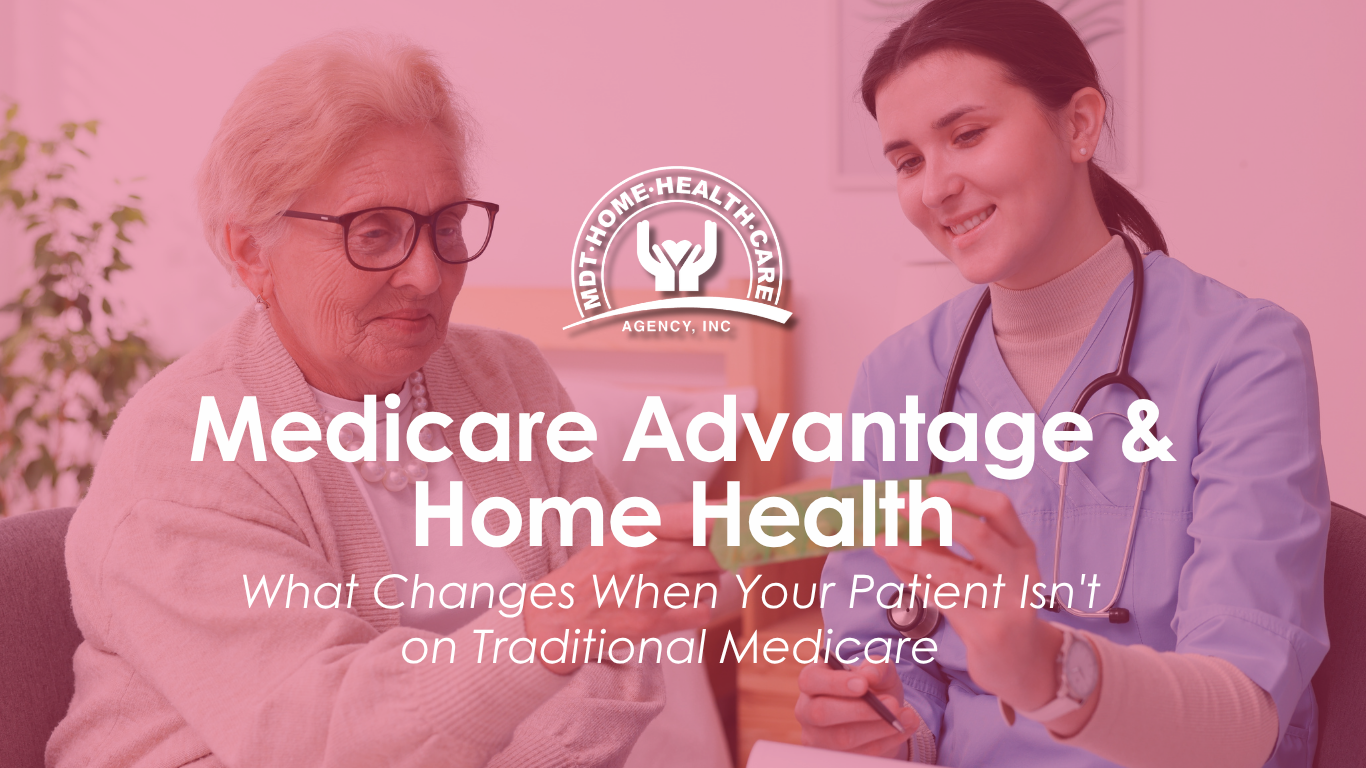
A Medicare Advantage home health referral often stalls for a reason that has nothing to do with medicine. The patient qualifies. Your documentation is solid. Still, care starts late, because the referral traveled a traditional Medicare route and the patient never had traditional Medicare.
In short, the clinical criteria did not change. Instead, the authorization path changed. That path is where most avoidable delays begin.
“Your clinical judgment does not need to change. Your workflow does.”
Medicare Advantage home health is now the majority case
According to KFF, 55 percent of eligible Medicare beneficiaries chose an Advantage plan in 2026. That is 35.2 million people out of 64.2 million.
In other words, this is no longer a segment. It is the norm. Therefore the referral in front of you is more likely than not an Advantage case, and the workflow you learned for traditional Medicare is now the exception.
Florida sharpens the point. KFF reports that Special Needs Plans make up 33 percent of Florida’s Advantage enrollment, among the highest rates in the country. Nationally, SNPs drove 85 percent of the net Advantage growth last year.
For a Miami-Dade discharge planner, the translation is simple. Many of your patients sit inside plans that run their own networks, their own rules, and their own care managers.
What does not change
Start here, because this is where the confusion begins. Advantage plans cover the same benefit categories as traditional Medicare. A patient who qualifies clinically still qualifies inside an Advantage plan.
Specifically, Medicare.gov sets four criteria:
Clinical criteria — unchanged
→ The patient stays homebound — leaving home takes considerable effort and help, or their condition makes it unwise
→ The patient needs part-time or intermittent skilled care — nursing, physical therapy, or speech-language pathology
→ A provider certifies the need after seeing the patient face-to-face
→ A Medicare-certified agency delivers the care
Also worth remembering: medical visits, short errands, religious services and adult day care do not break homebound status.
What a Medicare Advantage home health referral adds
The first difference carries a real cost. A referral you send at 4 p.m. on discharge day rarely has authorization in place when the patient reaches the front door. Yet those first days at home are exactly the window the referral protects.
The habit that fixes most of it
Nearly every avoidable delay in a Medicare Advantage home health referral traces back to one thing. The authorization started after the discharge decision instead of beside it.
“Start the authorization before the discharge order, not after.”
So put the home health conversation inside discharge planning, while the patient is still admitted and the case manager still has room to move. Discharge execution is too late. By then the clock already runs.
In practice, that means three moves. Name the plan early. Confirm network status before you commit to an agency. Then line up the certifying provider and the face-to-face note while you can still close a gap. For the rest of that transition, see our guide to what happens after the hospital.
The hospice exception worth knowing
Original Medicare always covers hospice, even when the patient holds a Medicare Advantage plan.
Once a patient elects hospice, Original Medicare’s rules govern the care tied to the terminal illness. The patient keeps the Advantage plan, which still covers unrelated conditions, unrelated drugs, and extras such as vision or dental. Source: Medicare Interactive.
This surprises experienced clinicians regularly. So if you are weighing a hospice referral for an Advantage patient, the plan is not the obstacle you expect.
A Medicare Advantage home health referral checklist
Run through this before you send it:
· Name the plan — not just “Medicare,” but which Advantage plan, and whether it is a Special Needs Plan
· Confirm the agency sits in network for that specific plan
· Name the certifying provider, then check that the face-to-face note exists
· Start the authorization before the discharge order
· Ask how many visits it covers, and when reauthorization comes due
· Ask whether the plan assigns a care manager, then get that contact
· Describe the homebound rationale in terms of effort — what leaving home actually takes — instead of asserting the label
None of this is clinical work. All of it decides whether the clinical work happens on time.
Where MDT fits
Medicare Advantage home health referrals reach our intake desk every week. Most of our patients carry Medicare, and MDT also works with other insurers. So if you cannot tell whether a plan works, or whether we hold a contract with it, ask before you rule the referral out. Learn more about our home health services or visit our referral page.
MDT Home Health Care Agency holds Medicare certification and Joint Commission accreditation, plus 24-hour on-call clinical support across Miami-Dade and Monroe County. Our intake team checks network status and authorization rules while your patient is still admitted, which is when that answer still helps.
Medicare Advantage home health starts with one call.
Call before you rule a referral out. We check network status and authorization rules while your patient is still admitted.
(305) 644-2100
Referrals with patient information: fax (786) 438-1353
This article serves licensed health care professionals and referral partners. It educates only. It does not give medical advice, and it does not determine coverage for any individual patient. Authorization and network rules vary by plan and change over time — verify each one with the plan directly. Coverage decisions depend on individual circumstances and current CMS guidance.
MDT Home Health Care Agency Inc. · Medicare Certified · Joint Commission Accredited · 24-Hour On-Call · Miami-Dade & Monroe County, Florida · mdthomehealth.com