Main Line: 305-644-2100
Fax: 305-644-2910
Email: info@mdthomehealth.com

HHA Support Through a Home Health Agency | MDT

Why HHA Support Through a Home Health Agency Matters After Discharge

HHA support through a home health agency can make a meaningful difference for patients after discharge, especially when they need help with personal care, safe routines, caregiver support, and continuity at home.

After discharge, many patients return home with instructions, medications, follow-up plans, and new safety needs. But the success of that transition often depends on what happens during everyday routines.

A patient may understand the discharge plan, but still need help bathing safely. Another patient may be medically stable, but weak, unsteady, forgetful, or unable to manage personal care alone. A family caregiver may be present, but overwhelmed by the amount of support the patient now requires.

In these situations, Home Health Aide support can become an important part of helping the patient remain safer at home. But it is not only the presence of an aide that matters. The structure behind that support matters too.

When HHA services are provided through a home health agency, the support is connected to supervision, documentation, communication, and the patient’s broader plan of care.


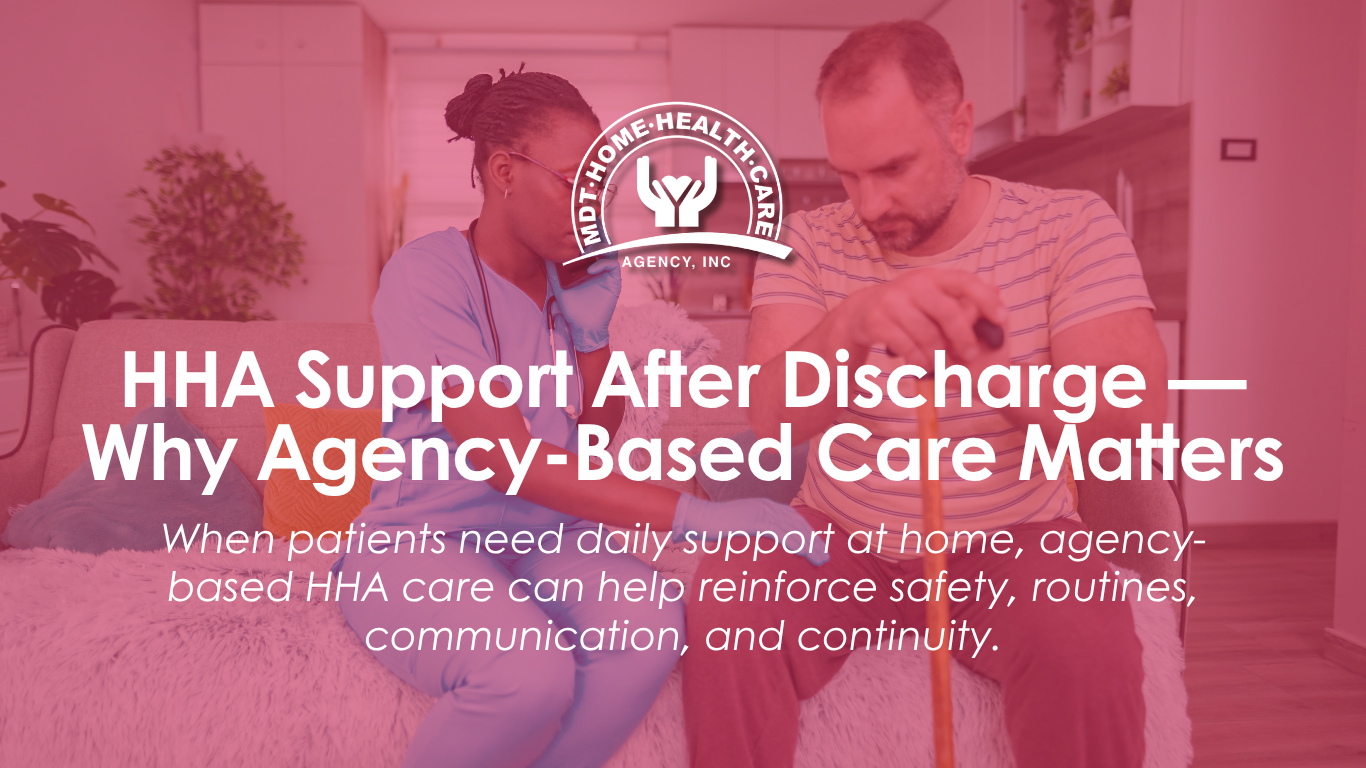
HHA support through a home health agency for an older adult patient at home

Why HHA Support Through a Home Health Agency Matters

Home Health Aides often support patients with activities of daily living and personal care needs. This may include assistance with bathing, grooming, dressing, mobility support, meal-related routines, hygiene, and maintaining a safer daily environment.

For patients recovering after hospitalization or managing chronic conditions, these daily tasks can directly affect safety and continuity.

A missed bath may not seem clinical at first, but hygiene issues can affect skin integrity. Unsafe transfers can increase fall risk. Inconsistent routines may affect medication reminders, nutrition, hydration, or the caregiver’s ability to monitor the patient. Small gaps at home can become larger concerns when there is no structure around the support being provided.

This is why HHA support through a home health agency can be valuable. It helps connect daily care needs with an organized care environment.

How HHA Support Through a Home Health Agency Creates Structure

A Home Health Aide working through a home health agency is not simply “someone helping at home.” The aide is part of a care structure that includes supervision, coordination, documentation, and communication.

This matters because the home setting is where care plans succeed or break down.

Agency-based HHA support can help:

  • Reinforce safe routines for personal care and mobility
  • Support activities of daily living in a consistent way
  • Identify changes or concerns that should be reported
  • Communicate observations through the agency’s care process
  • Support family caregivers who may feel overwhelmed
  • Strengthen continuity between skilled visits and daily routines
  • Help the patient maintain dignity, comfort, and safety at home

The aide does not replace the nurse, therapist, or physician. Instead, the aide supports the patient’s daily care environment and helps reinforce the plan of care within the appropriate scope of service.

What Can Happen Without Structured HHA Support

When patients rely only on informal or inconsistent support, important care needs can be missed.

This is especially relevant for patients who are elderly, recently discharged, functionally limited, cognitively impaired, or dependent on others for personal care.

Common risks may include:

  • Unsafe bathing or transfers
  • Increased fall risk during daily routines
  • Missed hygiene needs or skin concerns
  • Caregiver fatigue or burnout
  • Inconsistent support with meals, hydration, or personal care
  • Delayed reporting of changes in condition
  • Confusion about what should be communicated to the care team
  • Lack of documentation around patient concerns

These risks do not mean the family is not trying. Often, families are doing their best with limited training, limited time, or limited understanding of what the patient needs after discharge.

Structured home health support can help reduce those gaps.

The Role of the Home Health Aide in the Care Environment

A Home Health Aide can observe the patient in the setting where care is happening every day. This gives the agency a clearer picture of the patient’s functional needs, routines, and potential barriers.

The aide may notice that the patient is weaker than expected, that bathing is unsafe, that the caregiver is struggling, or that the patient needs more support than originally anticipated. These observations can be communicated through the agency so the appropriate team members can follow up.

This connection is important. It helps prevent the aide’s role from becoming isolated from the rest of the care plan.

In a coordinated home health model, HHA support through a home health agency contributes to a broader understanding of the patient’s needs at home.

How MDT Supports HHA Care Through an Agency Model

At MDT Home Health Care Agency, HHA support is integrated into a coordinated approach to home health care. Our team understands that the home environment is not separate from clinical outcomes. It is where the plan of care is carried out.

In practice, this may include:

  • Supporting patients with personal care and activities of daily living
  • Reinforcing safe routines in the home setting
  • Observing changes or concerns that should be communicated
  • Supporting family caregivers who may need additional structure
  • Helping reduce gaps between skilled visits and daily care needs
  • Coordinating HHA support within the agency’s care process
  • Maintaining communication across the care team when concerns arise
  • Supporting patient dignity, comfort, and safety at home

The goal is to help ensure that daily support is not disconnected from the patient’s overall care needs.

Why This Matters for Case Managers and Referral Partners

For discharge planners, case managers, clinical allies, and referral partners, the question is not only whether a patient has someone at home. The question is whether the patient’s support system is reliable, safe, and connected to the plan of care.

A patient may have a family caregiver, but that caregiver may be unavailable during the day. Another patient may have support, but still need help with personal care, hygiene, transfers, or safe routines. A patient may be discharged with instructions that require consistency, but the home environment may not be ready to support them.

These are the situations where HHA support through a home health agency can make a difference.

It helps create a more structured care environment around the patient.

When to Refer for HHA Support Through a Home Health Agency

Agency-based HHA support may be especially appropriate when:

  • A patient needs help with bathing, dressing, grooming, or personal care
  • The patient has difficulty with safe mobility or daily routines
  • There are concerns about falls, weakness, or functional decline
  • The patient has cognitive changes or needs supervision with routine tasks
  • Family caregivers are overwhelmed, inconsistent, or unavailable
  • The patient was recently discharged and needs support transitioning home
  • There are concerns about hygiene, skin integrity, or missed care
  • The care team wants daily support connected to agency supervision and communication
  • The patient needs help maintaining safety, dignity, and consistency at home

These indicators can help identify patients whose home environment may benefit from more structured support.

Supporting Safer Continuity at Home

Home health care is not only about skilled visits. It is also about helping the patient’s daily care environment support the plan of care.

When HHA support through a home health agency is provided through an organized care model, it can help reinforce routines, support caregivers, identify concerns, and connect daily care needs to the broader home health team.

For patients recovering after discharge or living with ongoing care needs, that structure can make a meaningful difference.

MDT Home Health Care Agency is Medicare-certified and Joint Commission accredited, serving Miami-Dade and Monroe County with 24-hour on-call clinical support.

For general information about Medicare home health coverage, patients and families can review Medicare’s official home health guidance.

To refer a patient who may benefit from HHA support through a home health agency, skilled home health coordination, and safer continuity of care at home, call 305-644-2100 or visit our MDT home health care resources.

To learn more about MDT’s home health care services in Miami-Dade and Monroe County, visit our website or contact our team.
Stroke Recovery at Home | MDT Home Health

Stroke Recovery at Home: What Patients and Caregivers Need After Discharge

After a stroke, the transition home can be one of the most important phases of recovery. A patient may leave the hospital or rehabilitation facility medically stable. However, daily life at home may still involve changes in mobility, strength, speech, swallowing, memory, medication routines, and safety.

In home health care, this period matters because recovery does not happen only during a hospital stay. It continues in the patient’s real environment: the bedroom, bathroom, kitchen, hallway, and daily routines where risks and progress both become visible.

For patients across Miami-Dade and Monroe County, skilled home health support can help bridge the gap between discharge instructions and what actually happens at home.

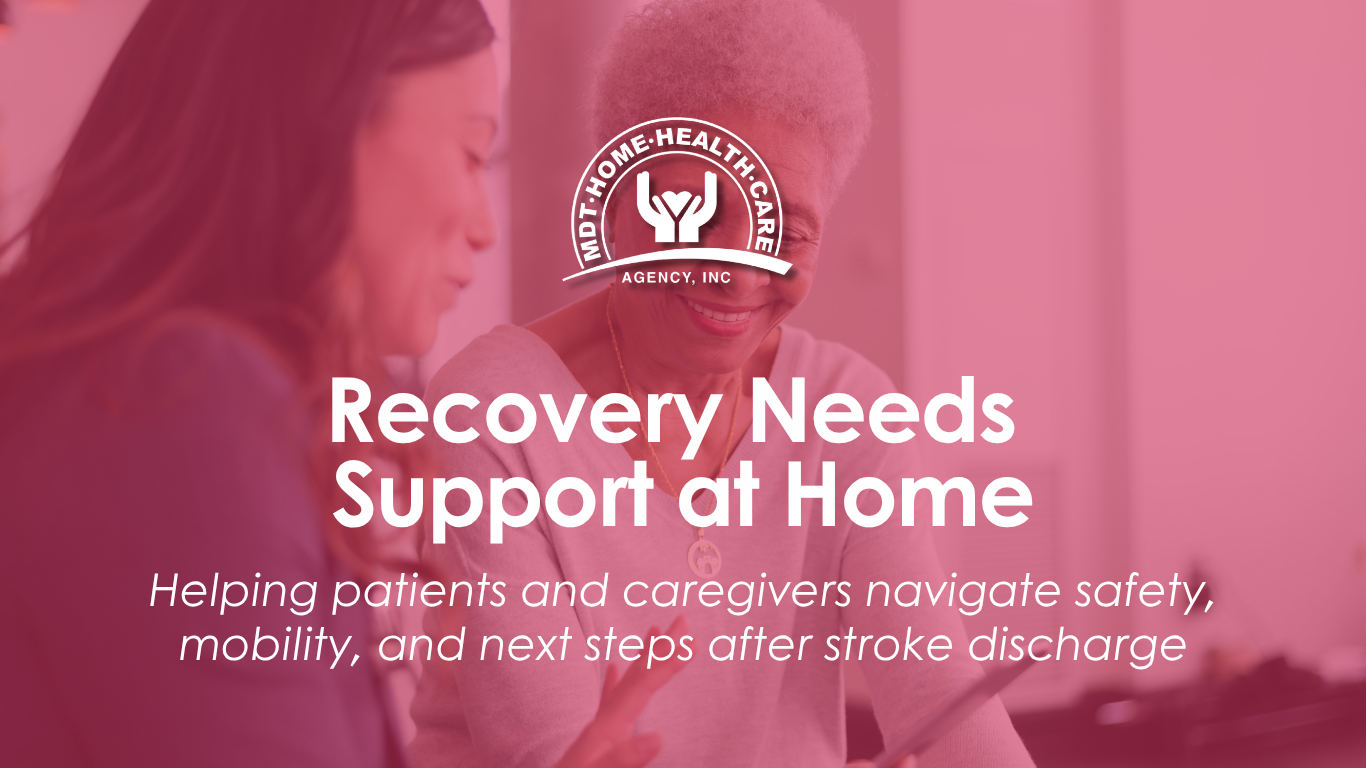
Helping patients and caregivers navigate safety, mobility, and next steps after stroke discharge

Why Stroke Recovery Requires Support at Home

Stroke recovery often involves more than one clinical need. Some patients return home with weakness on one side of the body. Others may have difficulty walking safely, using the bathroom, preparing meals, remembering medications, or communicating clearly.

At the same time, families and caregivers may want to help but may not know what changes are expected, what warning signs require attention, or how to support recovery without increasing risk.

This is especially important when the home environment has stairs, narrow spaces, clutter, limited caregiver availability, or routines that were safe before the stroke but are no longer safe afterward.

For this reason, a successful transition home requires structure, education, monitoring, and coordination.

For additional patient and caregiver education, the American Stroke Association offers stroke recovery resources that explain how rehabilitation can support independence and daily function after a stroke.

What Can Get Missed After Discharge

After a stroke, small gaps in understanding or follow-through can affect recovery. These gaps do not usually happen because of a lack of effort. In many cases, patients and caregivers are managing new information during an already stressful time.

Common challenges may include:

  • The patient or caregiver does not fully understand medication changes
  • New weakness, fatigue, or balance issues
  • Increased risk of falls during transfers, bathing, or walking
  • Difficulty following therapy exercises correctly
  • Speech, swallowing, or cognitive changes that affect daily routines
  • Caregiver uncertainty about what is safe or unsafe
  • Missed warning signs of decline or complications
  • Confusion about follow-up appointments or care instructions

In the home setting, these issues may not be obvious right away. However, they often become visible during daily routines.

The Role of Skilled Home Health in Stroke Recovery

Skilled home health care brings support into the home, where recovery continues every day. Nurses and therapists can observe how the patient is functioning, identify barriers, reinforce education, and communicate concerns across the care team.

For stroke recovery, the care team may include skilled nurses, physical therapists, occupational therapists, speech therapists, medical social workers, or home health aides when appropriate.

Each discipline plays a different role. However, the goal is shared: helping the patient recover as safely and effectively as possible while supporting the caregiver and family.

As a result, home health support can help patients and caregivers move from discharge instructions to safer daily routines.

How MDT Supports Stroke Recovery at Home

At MDT Home Health Care Agency, our team supports stroke recovery by focusing on the patient’s clinical needs, home environment, and caregiver support system.

In practice, this may include:

  • Reinforcing discharge instructions and medication routines
  • Monitoring changes in condition, symptoms, and safety concerns
  • Supporting mobility, balance, transfers, and fall prevention
  • Helping patients regain confidence with daily activities
  • Identifying communication, cognitive, or swallowing concerns that may need follow-up
  • Educating caregivers on safe routines and warning signs
  • Coordinating concerns across nurses, therapists, families, and physicians
  • Encouraging continuity between the plan of care and what is happening at home

Stroke recovery is not only about completing exercises or attending appointments. It is also about helping the patient and caregiver understand how to manage care safely between visits.

Why Caregiver Education Matters

After a stroke, caregivers often become essential to the recovery process. They may assist with walking, bathing, meals, medications, transportation, appointments, and emotional support.

However, caregiving after a stroke can be overwhelming, especially when the caregiver has not been trained on what to expect.

Caregivers may need guidance on:

  • How to help with transfers without causing injury
  • What symptoms should be reported
  • How to support medication adherence
  • How to encourage safe movement
  • How to reduce fall risks at home
  • How to respond to changes in speech, mood, memory, or behavior
  • When to contact the care team

When caregivers are better supported, the patient’s recovery environment becomes safer and more consistent.

When to Refer: Patients Who May Benefit from Stroke Recovery-Focused Home Health Care

Clinicians may consider a stroke recovery-focused home health referral when:

  • A patient was recently discharged after a stroke or transient ischemic attack
  • New weakness, balance issues, or mobility limitations are present
  • There are concerns about falls, transfers, or unsafe movement at home
  • Discharge instructions are difficult for the patient or caregiver to follow
  • Medication regimens changed after hospitalization
  • Changes in speech, swallowing, memory, or cognition affect daily routines
  • The caregiver is unsure how to support recovery safely
  • The patient lives alone or has limited support between visits
  • The family needs education on warning signs and care expectations

These signs can help identify patients who need support before avoidable complications occur.

Supporting Recovery Beyond Discharge

Stroke recovery is a process. The home setting can support that process, but it can also create new risks if the patient and caregiver are not properly guided.

With the right clinical support, patients can receive education, monitoring, therapy, and coordination in the place where recovery continues every day.

MDT Home Health Care Agency is Medicare-certified and Joint Commission accredited, serving Miami-Dade and Monroe County with 24-hour on-call clinical support.

To refer a patient who may benefit from skilled home health support, therapy coordination, and stroke recovery education at home, call 305-644-2100 or visit our MDT home health care resources.

To learn more about MDT’s home health care services in Miami-Dade and Monroe County, visit our website or contact our team.
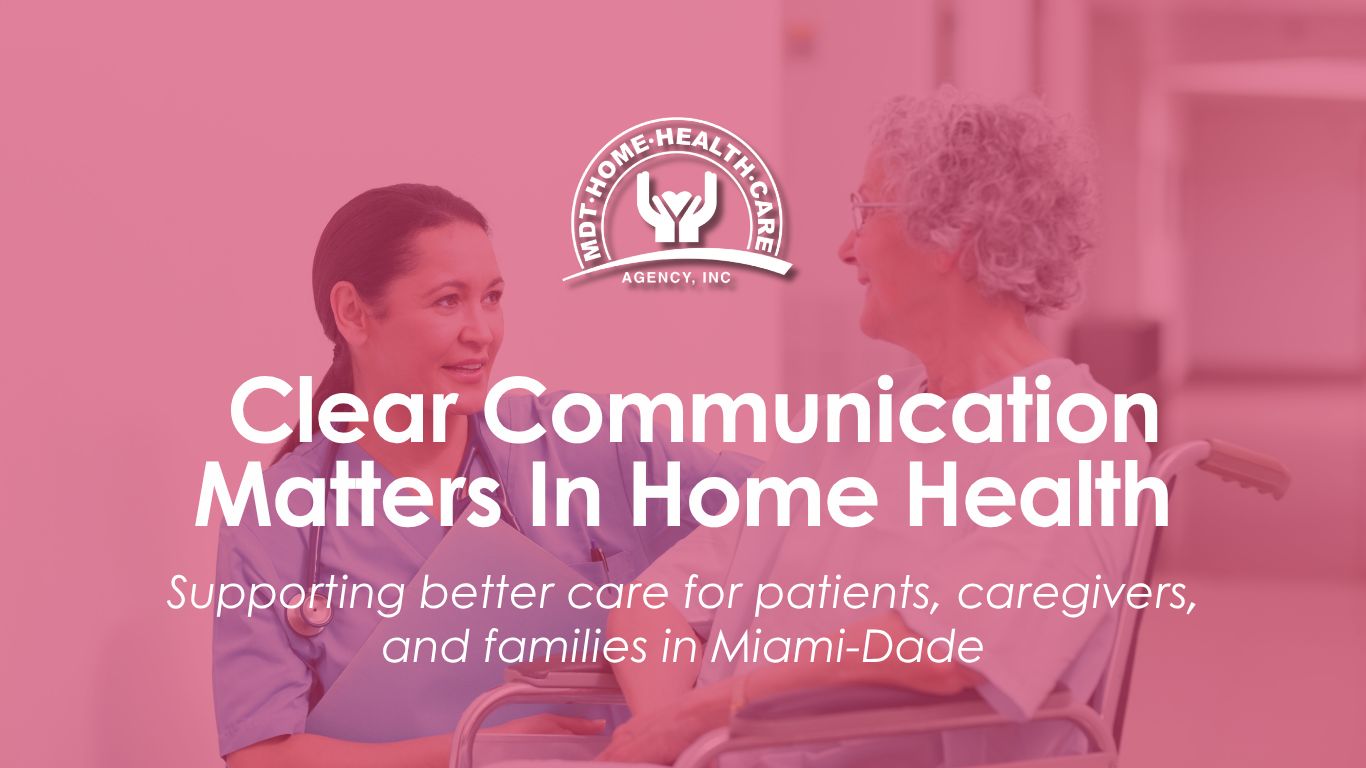
Communication Clarity in Home Health Care in Miami-Dade

In home health care, clinical outcomes depend on more than treatment plans, medication schedules, and follow-up visits. They also depend on whether the patient, caregiver, family, and care team clearly understand what needs to happen at home. Just as important, the clinical team needs to understand what is actually happening between visits. In Miami-Dade, many elderly patients, caregivers, and families navigate care in more than one language. Because of this, communication clarity is not just a courtesy. It is a clinical priority.

Skilled home health teams can help address this challenge through preparation, consistency, patient education, caregiver support, and the involvement of the people closest to the patient. Communication barriers do not always come from the patient alone. In many home health cases, the patient, caregiver, family members, and clinical team may each navigate care in different languages or at different levels of comfort.

For example, a patient may speak English while their daily caregiver feels more confident in Spanish. Another patient may speak Spanish while discharge instructions arrive in English. These realities do not mean anyone is doing something wrong. They show why the care team needs clear steps, simple documentation, and steady follow-up.

Clear communication between a home health caregiver, patient, and care team in Miami-Dade

Why Communication Clarity Affects Clinical Outcomes

When patients, caregivers, or family members do not fully understand care instructions, important steps can be missed. Medications may be taken incorrectly. Follow-up visits may be delayed. Warning signs may go unnoticed. These are not failures of commitment. They are often failures of communication, and they are preventable.

The home health setting creates a different communication environment than a clinic or hospital. There is no front desk, no discharge coordinator, and no physician available in the next room.

During each home visit, the skilled nurse or therapist carries the responsibility of clinical education in the patient’s real environment. Clear communication at home requires more than speaking slowly or giving printed instructions. The care team must understand how the patient and caregiver learn best. They also need to know who helps with daily care, what language support is needed, and how to repeat key instructions between visits.

What Gets in the Way

In home health care across Miami-Dade, communication barriers often appear in a few consistent ways:

• Discharge instructions may be written at a reading level or in a language the patient or caregiver does not navigate fluently
• Medication regimens may change at discharge without a clear explanation of what stopped, what continued, and what needs monitoring
• Patients, caregivers, or family members may nod and agree in the hospital but not fully process the information they received
• Daily caregivers may understand the patient’s routine but still need clearer clinical instructions to support care safely
• Family members may help with decisions but not always be present during home visits
• Health beliefs, prior experiences, or fear may shape how a patient or caregiver interprets clinical guidance

How MDT Addresses Communication in Practice

At MDT Home Health Care Agency, our team treats communication as part of the clinical plan of care — not as a soft skill layered on top of it. Our nurses and therapists working across Miami-Dade and Monroe County use a structured approach that reflects the realities of each patient’s home environment.

In practice, this means:

• Repeating and reinforcing key information across multiple visits instead of delivering it once and moving on
• Involving family members and informal caregivers in clinical education when the patient identifies them as part of their support system
• Using translation resources, visual aids, and simplified instruction formats when standard written materials are insufficient
• Confirming understanding through teach-back by asking the patient or caregiver to explain the information back in their own words
• Clinicians document communication barriers in the clinical record and flag them for the full care team
• Supporting communication between clinicians, patients, caregivers, and families so important changes are not lost between visits

The Role of the Care Team, Patient, and Family

Effective communication in home health is ongoing. It requires coordination at every step.

Patients need to feel safe asking questions. Caregivers should know what to watch for and who to call. Families also play an important role in supporting the plan of care. Across disciplines, clinicians must communicate clearly so changes, concerns, and barriers are not missed. The skilled nurse plays a central role, but communication clarity depends on coordination across the full care environment.

When a physical therapist identifies that a patient has been doing exercises incorrectly because the instructions were misunderstood, that information must reach the skilled nurse. If the nurse notices that a caregiver is consistently absent, overwhelmed, or unclear about the care plan, the care team may involve the medical social worker.

Communication is not a single event. It is part of continuity of care.

When to Refer: Patients Who Benefit from a Communication-Focused Care Plan

A communication-focused home health plan may be especially important when:

• A patient was recently discharged with complex or changed medication regimens
• Written instructions are difficult for the patient or caregiver to understand
• The primary caregiver navigates care in a different language than the patient, family, or discharge instructions
• The patient lives alone and has no caregiver present to reinforce clinical education
• The family has expressed confusion about care expectations after a prior hospitalization
• Clinical instructions are not translating clearly into daily home routines

For general information about Medicare home health care services, patients and families can also review Medicare’s official guidance.

MDT Home Health Care Agency is Medicare-certified and Joint Commission accredited, serving Miami-Dade and Monroe County with 24-hour on-call clinical support.

To refer a patient who may benefit from skilled home health support, clearer care coordination, and communication-focused education at home, call 305-644-2100 or visit mdthomehealth.com/news.

To learn more about MDT’s home health care services in Miami-Dade and Monroe County, visit our website or contact our team.