

Main Line: 305-644-2100
Fax: 305-644-2910
Email: info@mdthomehealth.com

Medicare Advantage Home Health Referrals Miami | MDT


Medicare Advantage Home Health · Referral Guide · Miami-Dade & Monroe County

Medicare Advantage home health referrals follow the same clinical rules. The paperwork is what changed.

MDT Home Health Care  ·  Miami-Dade & Monroe County  ·  August 2026
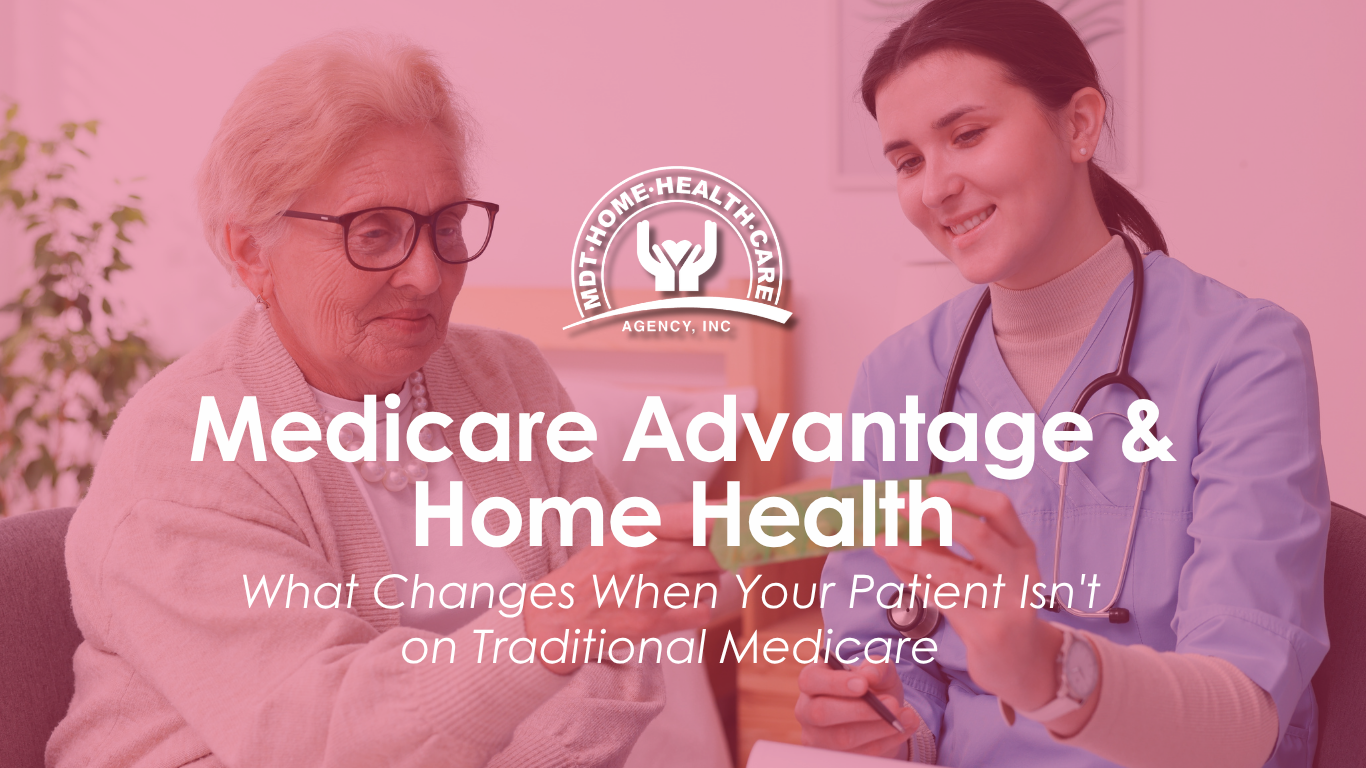

Medicare Advantage home health Miami — case manager reviewing plan authorization before discharge


A Medicare Advantage home health referral often stalls for a reason that has nothing to do with medicine. The patient qualifies. Your documentation is solid. Still, care starts late, because the referral traveled a traditional Medicare route and the patient never had traditional Medicare.

In short, the clinical criteria did not change. Instead, the authorization path changed. That path is where most avoidable delays begin.

“Your clinical judgment does not need to change. Your workflow does.”

Medicare Advantage home health is now the majority case

According to KFF, 55 percent of eligible Medicare beneficiaries chose an Advantage plan in 2026. That is 35.2 million people out of 64.2 million.

In other words, this is no longer a segment. It is the norm. Therefore the referral in front of you is more likely than not an Advantage case, and the workflow you learned for traditional Medicare is now the exception.

Florida sharpens the point. KFF reports that Special Needs Plans make up 33 percent of Florida’s Advantage enrollment, among the highest rates in the country. Nationally, SNPs drove 85 percent of the net Advantage growth last year.

For a Miami-Dade discharge planner, the translation is simple. Many of your patients sit inside plans that run their own networks, their own rules, and their own care managers.

What does not change

Start here, because this is where the confusion begins. Advantage plans cover the same benefit categories as traditional Medicare. A patient who qualifies clinically still qualifies inside an Advantage plan.

Specifically, Medicare.gov sets four criteria:

Clinical criteria — unchanged

→  The patient stays homebound — leaving home takes considerable effort and help, or their condition makes it unwise

→  The patient needs part-time or intermittent skilled care — nursing, physical therapy, or speech-language pathology

→  A provider certifies the need after seeing the patient face-to-face

→  A Medicare-certified agency delivers the care

Also worth remembering: medical visits, short errands, religious services and adult day care do not break homebound status.

What a Medicare Advantage home health referral adds

Four operational differences

1 · Prior authorization comes first

Traditional Medicare pays for a certified episode without pre-approval. Advantage plans usually want authorization before care starts, and they often approve a set number of visits instead of an open episode.

2 · Networks matter

A Medicare-certified agency does not automatically sit inside every Advantage network. Certified and contracted mean two different things.

3 · Reauthorization

Care past the approved visits needs a new request. A plan that made sense on day one may need fresh justification on day fifteen.

4 · Plan-side care management

Many Advantage plans, and nearly every Special Needs Plan, assign their own care manager. That helps. It also adds one more person to coordinate with.

The first difference carries a real cost. A referral you send at 4 p.m. on discharge day rarely has authorization in place when the patient reaches the front door. Yet those first days at home are exactly the window the referral protects.

The habit that fixes most of it

Nearly every avoidable delay in a Medicare Advantage home health referral traces back to one thing. The authorization started after the discharge decision instead of beside it.

“Start the authorization before the discharge order, not after.”

So put the home health conversation inside discharge planning, while the patient is still admitted and the case manager still has room to move. Discharge execution is too late. By then the clock already runs.

In practice, that means three moves. Name the plan early. Confirm network status before you commit to an agency. Then line up the certifying provider and the face-to-face note while you can still close a gap. For the rest of that transition, see our guide to what happens after the hospital.

The hospice exception worth knowing

Original Medicare always covers hospice, even when the patient holds a Medicare Advantage plan.

Once a patient elects hospice, Original Medicare’s rules govern the care tied to the terminal illness. The patient keeps the Advantage plan, which still covers unrelated conditions, unrelated drugs, and extras such as vision or dental. Source: Medicare Interactive.

This surprises experienced clinicians regularly. So if you are weighing a hospice referral for an Advantage patient, the plan is not the obstacle you expect.

A Medicare Advantage home health referral checklist

Run through this before you send it:

·  Name the plan — not just “Medicare,” but which Advantage plan, and whether it is a Special Needs Plan

·  Confirm the agency sits in network for that specific plan

·  Name the certifying provider, then check that the face-to-face note exists

·  Start the authorization before the discharge order

·  Ask how many visits it covers, and when reauthorization comes due

·  Ask whether the plan assigns a care manager, then get that contact

·  Describe the homebound rationale in terms of effort — what leaving home actually takes — instead of asserting the label

None of this is clinical work. All of it decides whether the clinical work happens on time.

Where MDT fits

Medicare Advantage home health referrals reach our intake desk every week. Most of our patients carry Medicare, and MDT also works with other insurers. So if you cannot tell whether a plan works, or whether we hold a contract with it, ask before you rule the referral out. Learn more about our home health services or visit our referral page.

MDT Home Health Care Agency holds Medicare certification and Joint Commission accreditation, plus 24-hour on-call clinical support across Miami-Dade and Monroe County. Our intake team checks network status and authorization rules while your patient is still admitted, which is when that answer still helps.

Medicare Advantage home health starts with one call.

Call before you rule a referral out. We check network status and authorization rules while your patient is still admitted.

(305) 644-2100

Referrals with patient information: fax (786) 438-1353

Ask About a Case →

This article serves licensed health care professionals and referral partners. It educates only. It does not give medical advice, and it does not determine coverage for any individual patient. Authorization and network rules vary by plan and change over time — verify each one with the plan directly. Coverage decisions depend on individual circumstances and current CMS guidance.

MDT Home Health Care Agency Inc.  ·  Medicare Certified  ·  Joint Commission Accredited  ·  24-Hour On-Call  ·  Miami-Dade & Monroe County, Florida  ·  mdthomehealth.com
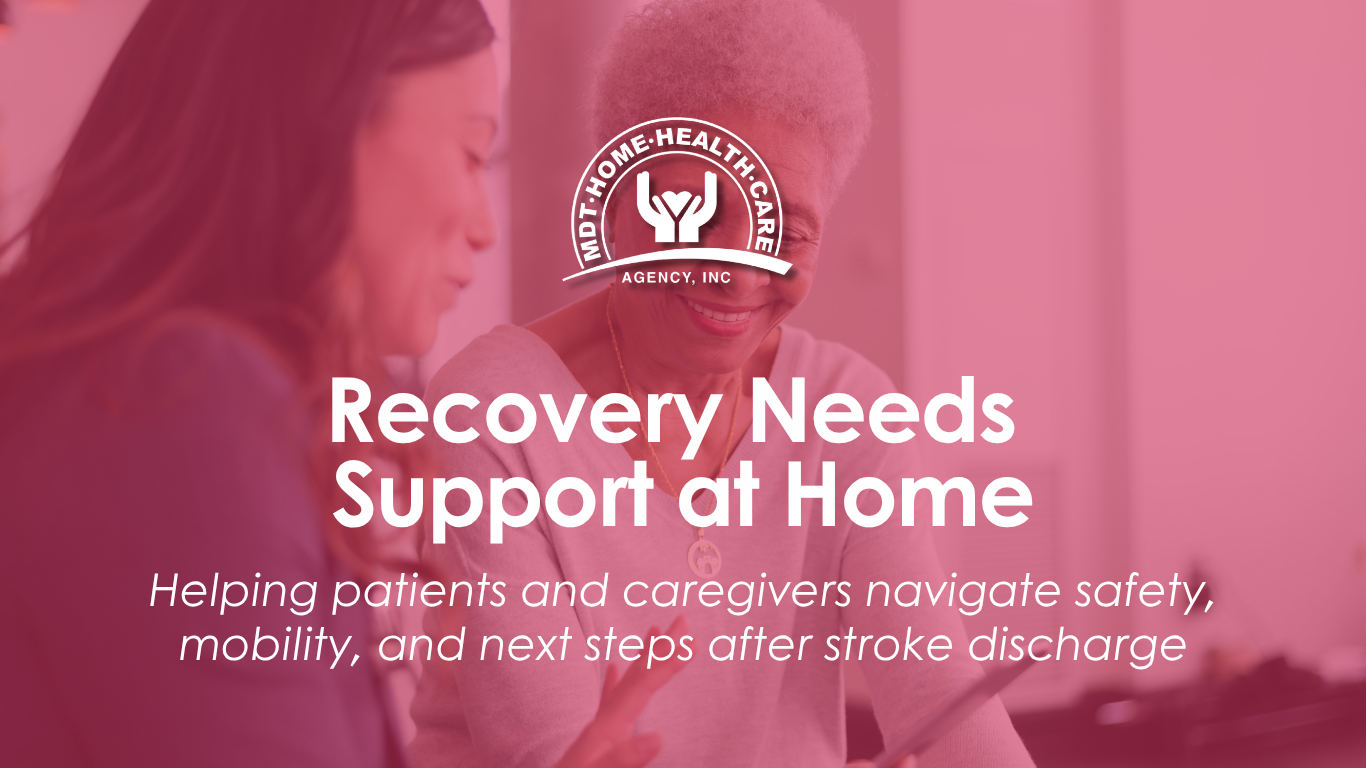
Stroke Recovery at Home | MDT Home Health

Stroke Recovery at Home: What Patients and Caregivers Need After Discharge

After a stroke, the transition home can be one of the most important phases of recovery. A patient may leave the hospital or rehabilitation facility medically stable. However, daily life at home may still involve changes in mobility, strength, speech, swallowing, memory, medication routines, and safety.

In home health care, this period matters because recovery does not happen only during a hospital stay. It continues in the patient’s real environment: the bedroom, bathroom, kitchen, hallway, and daily routines where risks and progress both become visible.

For patients across Miami-Dade and Monroe County, skilled home health support can help bridge the gap between discharge instructions and what actually happens at home.

Helping patients and caregivers navigate safety, mobility, and next steps after stroke discharge

Why Stroke Recovery Requires Support at Home

Stroke recovery often involves more than one clinical need. Some patients return home with weakness on one side of the body. Others may have difficulty walking safely, using the bathroom, preparing meals, remembering medications, or communicating clearly.

At the same time, families and caregivers may want to help but may not know what changes are expected, what warning signs require attention, or how to support recovery without increasing risk.

This is especially important when the home environment has stairs, narrow spaces, clutter, limited caregiver availability, or routines that were safe before the stroke but are no longer safe afterward.

For this reason, a successful transition home requires structure, education, monitoring, and coordination.

For additional patient and caregiver education, the American Stroke Association offers stroke recovery resources that explain how rehabilitation can support independence and daily function after a stroke.

What Can Get Missed After Discharge

After a stroke, small gaps in understanding or follow-through can affect recovery. These gaps do not usually happen because of a lack of effort. In many cases, patients and caregivers are managing new information during an already stressful time.

Common challenges may include:

  • The patient or caregiver does not fully understand medication changes
  • New weakness, fatigue, or balance issues
  • Increased risk of falls during transfers, bathing, or walking
  • Difficulty following therapy exercises correctly
  • Speech, swallowing, or cognitive changes that affect daily routines
  • Caregiver uncertainty about what is safe or unsafe
  • Missed warning signs of decline or complications
  • Confusion about follow-up appointments or care instructions

In the home setting, these issues may not be obvious right away. However, they often become visible during daily routines.

The Role of Skilled Home Health in Stroke Recovery

Skilled home health care brings support into the home, where recovery continues every day. Nurses and therapists can observe how the patient is functioning, identify barriers, reinforce education, and communicate concerns across the care team.

For stroke recovery, the care team may include skilled nurses, physical therapists, occupational therapists, speech therapists, medical social workers, or home health aides when appropriate.

Each discipline plays a different role. However, the goal is shared: helping the patient recover as safely and effectively as possible while supporting the caregiver and family.

As a result, home health support can help patients and caregivers move from discharge instructions to safer daily routines.

How MDT Supports Stroke Recovery at Home

At MDT Home Health Care Agency, our team supports stroke recovery by focusing on the patient’s clinical needs, home environment, and caregiver support system.

In practice, this may include:

  • Reinforcing discharge instructions and medication routines
  • Monitoring changes in condition, symptoms, and safety concerns
  • Supporting mobility, balance, transfers, and fall prevention
  • Helping patients regain confidence with daily activities
  • Identifying communication, cognitive, or swallowing concerns that may need follow-up
  • Educating caregivers on safe routines and warning signs
  • Coordinating concerns across nurses, therapists, families, and physicians
  • Encouraging continuity between the plan of care and what is happening at home

Stroke recovery is not only about completing exercises or attending appointments. It is also about helping the patient and caregiver understand how to manage care safely between visits.

Why Caregiver Education Matters

After a stroke, caregivers often become essential to the recovery process. They may assist with walking, bathing, meals, medications, transportation, appointments, and emotional support.

However, caregiving after a stroke can be overwhelming, especially when the caregiver has not been trained on what to expect.

Caregivers may need guidance on:

  • How to help with transfers without causing injury
  • What symptoms should be reported
  • How to support medication adherence
  • How to encourage safe movement
  • How to reduce fall risks at home
  • How to respond to changes in speech, mood, memory, or behavior
  • When to contact the care team

When caregivers are better supported, the patient’s recovery environment becomes safer and more consistent.

When to Refer: Patients Who May Benefit from Stroke Recovery-Focused Home Health Care

Clinicians may consider a stroke recovery-focused home health referral when:

  • A patient was recently discharged after a stroke or transient ischemic attack
  • New weakness, balance issues, or mobility limitations are present
  • There are concerns about falls, transfers, or unsafe movement at home
  • Discharge instructions are difficult for the patient or caregiver to follow
  • Medication regimens changed after hospitalization
  • Changes in speech, swallowing, memory, or cognition affect daily routines
  • The caregiver is unsure how to support recovery safely
  • The patient lives alone or has limited support between visits
  • The family needs education on warning signs and care expectations

These signs can help identify patients who need support before avoidable complications occur.

Supporting Recovery Beyond Discharge

Stroke recovery is a process. The home setting can support that process, but it can also create new risks if the patient and caregiver are not properly guided.

With the right clinical support, patients can receive education, monitoring, therapy, and coordination in the place where recovery continues every day.

MDT Home Health Care Agency is Medicare-certified and Joint Commission accredited, serving Miami-Dade and Monroe County with 24-hour on-call clinical support.

To refer a patient who may benefit from skilled home health support, therapy coordination, and stroke recovery education at home, call 305-644-2100 or visit our MDT home health care resources.

To learn more about MDT’s home health care services in Miami-Dade and Monroe County, visit our website or contact our team.