Main Line: 305-644-2100
Fax: 305-644-2910
Email: info@mdthomehealth.com

Diabetes Management at Home Miami | MDT


Diabetes Management at Home Miami · Chronic Condition Care · Miami-Dade & Monroe County

Diabetes management at home Miami is a daily job that doesn’t pause between doctor visits. Here is what skilled home health support actually looks like.

MDT Home Health Care  ·  Miami-Dade & Monroe County  ·  July 2026


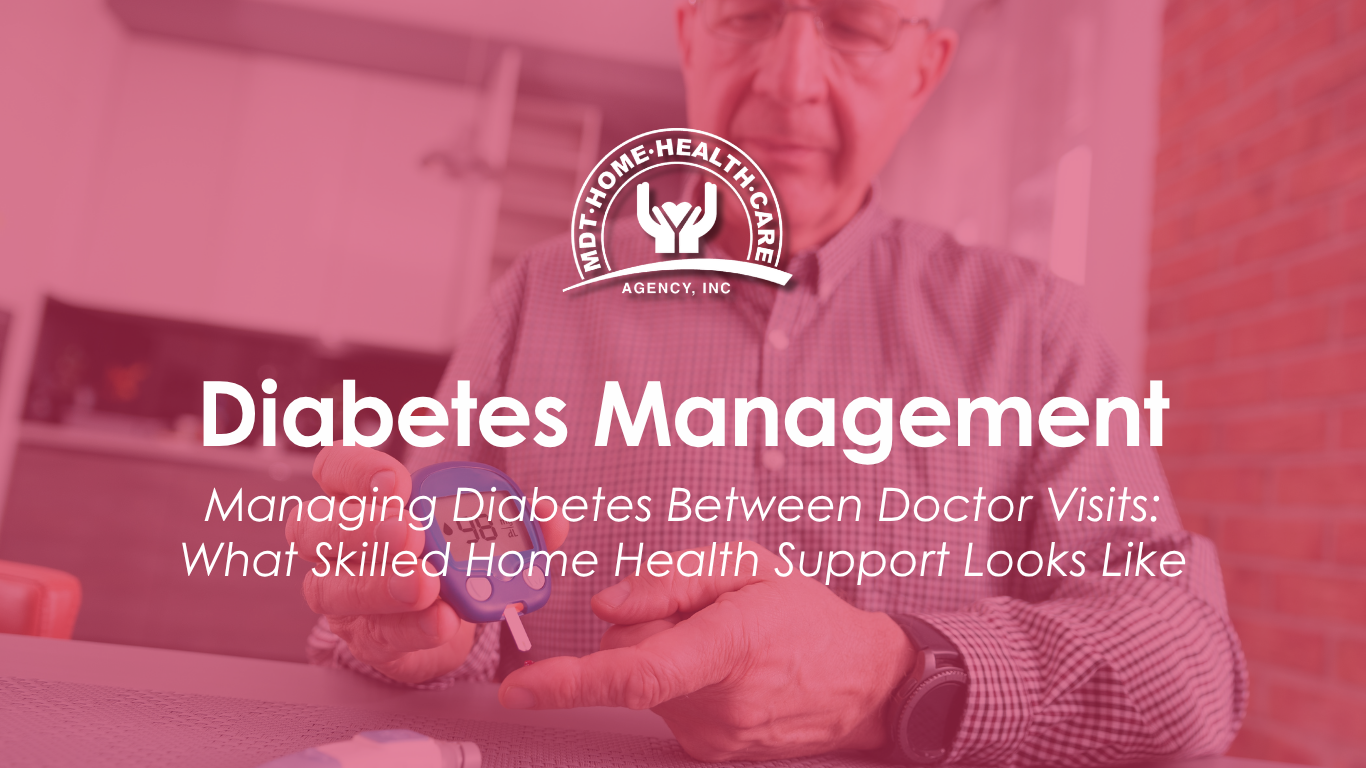
Diabetes management at home Miami — nurse reviewing glucose monitor with patient


Managing diabetes is, in a real sense, a daily job. Diabetes management at home involves blood sugar monitoring, medication timing, dietary choices, foot care, and recognizing the early signs of highs or lows — all of it happening continuously, between scheduled physician visits.

Additionally, for patients who are newly diagnosed, recently hospitalized for a diabetes-related complication, or managing a regimen that has become more complex, this daily responsibility can be more than a family can safely take on without clinical support.

“A single blood sugar reading means less than understanding the pattern over time — and most families aren’t trained to interpret that pattern.”

Why diabetes management at home Miami is harder than it looks from the outside

Diabetes management sounds straightforward in the abstract — check blood sugar, take medication, eat well. In practice, several factors make day-to-day management genuinely difficult.

Medication complexity. Specifically, many patients manage multiple medications, including insulin with specific timing and dosing requirements that can change based on blood sugar readings, food intake, and activity level.

Recognizing patterns, not just numbers. Importantly, a single reading means less than understanding the pattern over time, and knowing when it warrants a call to the physician.

Physical complications. Notably, diabetes increases the risk of wound healing problems, particularly on the feet, which require vigilant care and early intervention. According to the CDC, diabetes-related complications remain a leading cause of hospitalization and lower-limb amputation, which is why early foot assessment matters.

The emotional weight of chronic management. Furthermore, unlike an acute illness with an endpoint, diabetes management is ongoing — which can lead to fatigue and inconsistency over time, not from lack of effort, but from the sheer duration of the responsibility.

What skilled nursing support for diabetes includes

Therefore, when a patient is referred to home health for diabetes-related skilled nursing, the visit is grounded in the physician’s plan of care.

Typically includes

→  Blood glucose monitoring and pattern review as ordered, watching for trends that need physician attention

→  Insulin administration and education — correct technique, timing, and storage for patients and caregivers

→  Foot assessment for skin breakdown, wounds, or circulation concerns

→  Medication review, nutrition education, and physician communication when findings fall outside expected parameters

Who is appropriate for diabetes-focused home health support

A home health referral for diabetes management may be appropriate when a patient:

·  Has been recently diagnosed with diabetes and needs structured education on management at home

·  Has been hospitalized for a diabetes-related complication and requires skilled nursing support during the transition home

·  Is starting insulin therapy and needs hands-on instruction and monitoring

·  Has a wound or foot concern related to diabetes that requires skilled assessment

For patients in Miami-Dade and Monroe County, Medicare-covered home health requires a physician’s order and confirmation that the patient meets homebound status under current Medicare guidelines. Learn more about our home health services or visit our referral page for specific eligibility questions.

What diabetes management at home Miami looks like at MDT

Ultimately, at MDT Home Health Care, skilled nursing support for diabetes is built around the physician’s plan of care and the patient’s specific situation.

MDT Diabetes Management Process

Initial assessment

Of the patient’s current routine, medication regimen, monitoring habits, and any existing complications.

Hands-on education

For patient and caregiver, repeated as needed until correct technique is demonstrated.

Ongoing monitoring visits

At the frequency ordered by the physician, with attention to glucose patterns, foot health, and adherence.

Direct physician communication

When our skilled nurses observe a pattern or finding that warrants attention.

Furthermore, MDT Home Health Care serves patients across Miami-Dade and Monroe County, Florida. We are Medicare-certified and Joint Commission accredited, with 24-hour on-call clinical support.

A note for families

In short, if you’re supporting a loved one with diabetes and find yourself unsure about insulin dosing, worried about a wound that doesn’t seem to be healing, or simply exhausted by the daily responsibility of managing the condition — those are reasonable things to feel, and they are exactly what skilled home health support exists to address. For more on managing medications safely at home, see our guide to medication management after discharge.

Diabetes management between doctor visits is real clinical work.

Even when it happens at the kitchen table instead of a medical office, it requires structure, education, and an extra set of trained eyes.

At MDT Home Health Care, that is what our skilled nursing team is here to provide.

Contact MDT to Refer a Patient →

MDT Home Health Care  ·  Medicare Certified  ·  Joint Commission Accredited  ·  24-Hour On-Call  ·  Miami-Dade & Monroe County, Florida
COPD Care at Home Miami | Skilled Nursing | MDT


COPD Care at Home Miami · Respiratory Support · Miami-Dade & Monroe County

COPD care at home Miami means catching the warning signs early, before a bad day becomes a hospital readmission.

MDT Home Health Care  ·  Miami-Dade & Monroe County  ·  July 2026


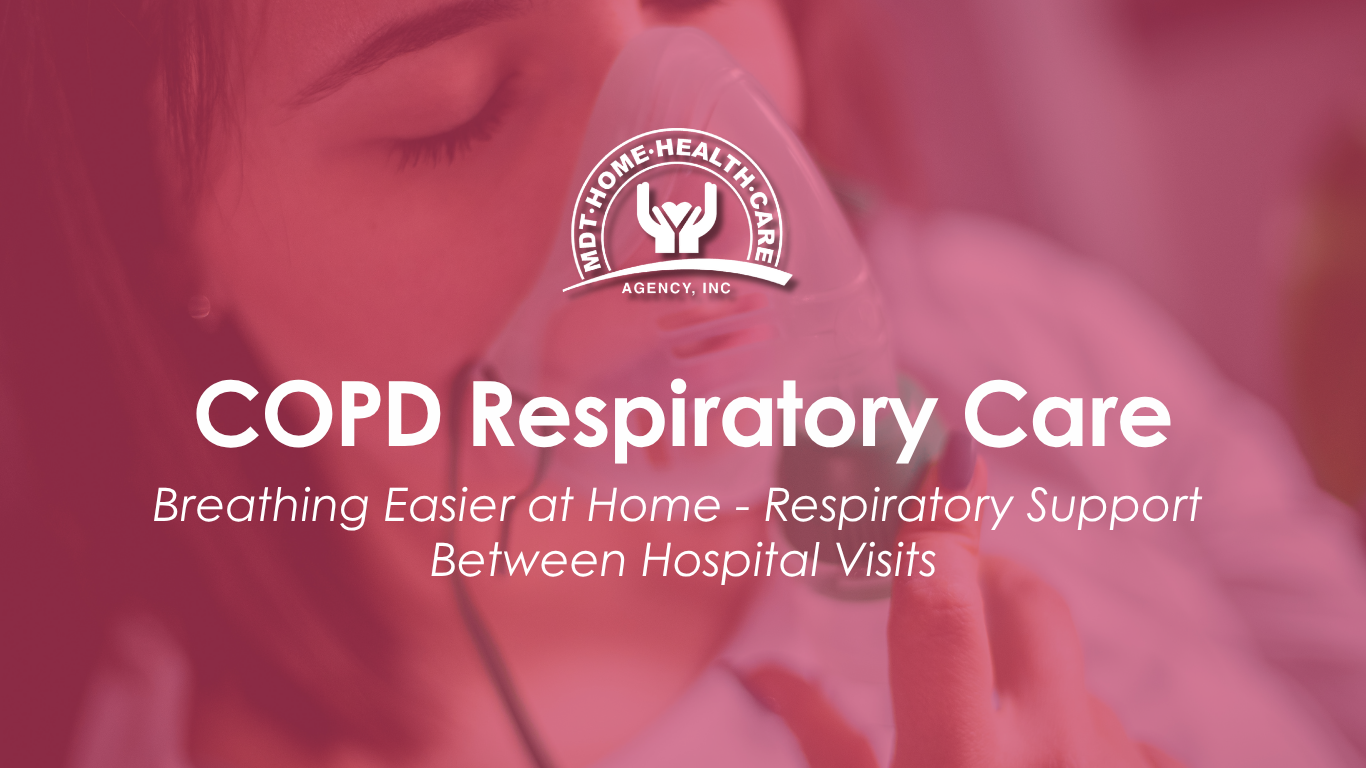
COPD care at home Miami — nurse assisting patient with oxygen therapy


For patients managing COPD, daily life involves a kind of ongoing risk assessment most people never have to think about: is this shortness of breath normal, or the start of something more serious? COPD care at home exists to help answer that question before it becomes an emergency.

In fact, COPD exacerbations are a leading cause of hospital readmission among patients with chronic respiratory disease, according to the CDC. The difference between a manageable flare-up and a hospital stay often comes down to how early the signs are recognized.

Ultimately, that judgment call matters — and it’s not one families should have to make without clinical support.

“A nurse who has seen the patient’s baseline respiratory status is in a much better position to notice when something is trending in the wrong direction.”

Why COPD care at home Miami requires ongoing attention

COPD is a progressive condition, which means a patient’s baseline can shift gradually over time — making it harder for the patient or family to recognize when something has actually changed versus when it’s simply “how things are now.”

For example, regular skilled visits create a consistent point of comparison. A nurse who has seen the patient’s baseline respiratory status, oxygen needs, and typical symptom pattern is in a much better position to notice when something is trending in the wrong direction.

What respiratory support at home includes

Importantly, skilled nursing visits for patients managing COPD follow the physician’s plan of care directly.

Typically includes

→  Respiratory assessment — lung sounds, respiratory rate and effort, oxygen saturation, compared against baseline

→  Oxygen therapy management — confirming correct flow rate, equipment use, and patient understanding

→  Medication review — including inhaler and nebulizer technique, commonly done incorrectly without instruction

→  Early exacerbation recognition — educating on signs like increased shortness of breath, sputum changes, or unusual fatigue

→  Breathing technique instruction and physician communication when early warning signs appear

Who is appropriate for COPD home health support

A home health referral for COPD-focused respiratory care may be appropriate when a patient:

·  Has a physician’s order for skilled nursing related to COPD management, including patients recently discharged after an exacerbation

·  Uses supplemental oxygen and requires education or monitoring related to its use

·  Has had a recent COPD exacerbation and needs support during the recovery period

·  Has had difficulty using inhalers or nebulizer equipment correctly

For patients in Miami-Dade and Monroe County, Medicare-covered home health requires a physician’s order and confirmation that the patient meets homebound status under current Medicare guidelines. Learn more about our home health services or visit our referral page for specific eligibility questions.

What COPD care at home Miami looks like at MDT

Therefore, at MDT Home Health Care, skilled nursing support for COPD centers on consistent, ongoing assessment rather than one-time instruction.

MDT COPD Care Process

Baseline assessment

During the initial visit, establishing the patient’s typical respiratory status, oxygen needs, and functional capacity.

Regular monitoring visits

At the frequency ordered by the physician, with comparison against the established baseline at each visit.

Hands-on technique instruction

For inhalers, nebulizers, and oxygen equipment, repeated as needed until correct use is demonstrated.

Direct physician communication

When our skilled nurses observe signs that may indicate an early exacerbation.

Additionally, MDT Home Health Care serves patients across Miami-Dade and Monroe County, Florida. We are Medicare-certified and Joint Commission accredited, with 24-hour on-call clinical support.

A note for families

In short, if you’re caring for someone with COPD and you’ve noticed they seem to be struggling more than usual — more breathless, more tired, coughing more — that instinct is worth trusting. Skilled home health support exists specifically to help families tell the difference between a difficult day and a developing problem. For more on managing chronic conditions at home, see our guide to chronic disease monitoring at home.

COPD management at home is an ongoing relationship, not a single conversation.

It allows changes to be caught early, before they become a reason to go back to the hospital.

At MDT Home Health Care, that is what our skilled nursing team is here to provide.

Contact MDT to Refer a Patient →

MDT Home Health Care  ·  Medicare Certified  ·  Joint Commission Accredited  ·  24-Hour On-Call  ·  Miami-Dade & Monroe County, Florida
IV Therapy at Home Miami | Skilled Nursing | MDT


IV Therapy at Home Miami · Skilled Nursing · Miami-Dade & Monroe County

IV therapy at home Miami means completing hospital-level treatment safely, without extending an already exhausting hospital stay.

MDT Home Health Care  ·  Miami-Dade & Monroe County  ·  July 2026


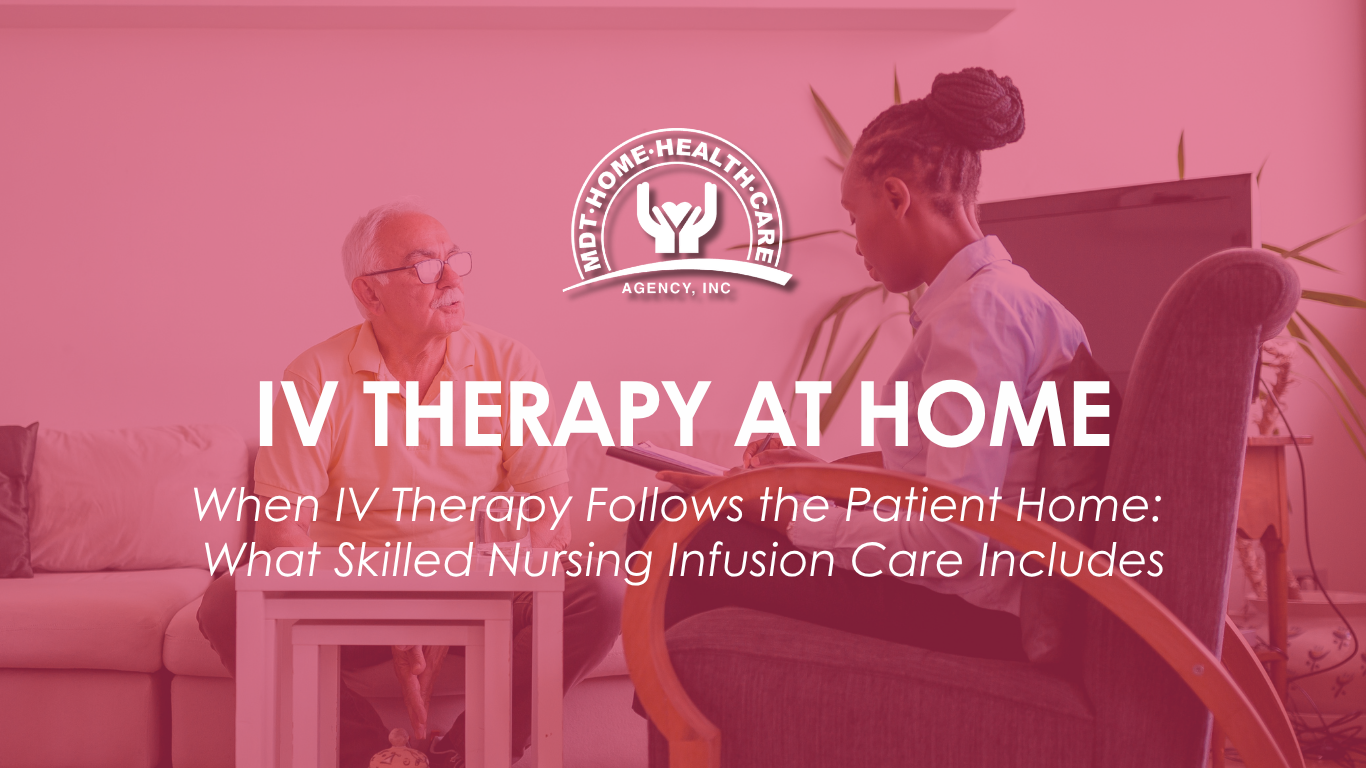
IV therapy at home Miami — nurse administering home infusion care


For some patients, the course of treatment that started in the hospital isn’t finished when discharge day arrives. IV therapy at home allows that treatment to continue — in a familiar environment, with skilled nursing oversight, rather than an extended hospital stay.

IV antibiotics, hydration therapy, or other infusion treatments may need to continue for days or weeks after discharge. Increasingly, that continuation happens at home.

Managing this safely requires real clinical oversight — line care, infection monitoring, medication administration, and direct physician coordination, not a simple continuation of a hospital routine.

“The IV treatment itself is often what’s keeping a stable patient in the hospital bed — not their overall condition.”

Why IV therapy at home Miami matters

In fact, hospitals increasingly discharge patients who still require intravenous treatment, particularly for infections that respond to antibiotics but require a multi-week course. Completing that course in a hospital bed is often unnecessary once a patient is medically stable.

Home IV therapy, when ordered by a physician and supported by skilled nursing, allows patients to recover in a familiar environment while continuing necessary treatment. For example, this is most common with IV antibiotic therapy, but also applies to hydration therapy, certain pain management protocols, and some chemotherapy support regimens.

What skilled nursing IV care includes

Importantly, managing IV therapy at home is not the same as administering a single dose. It is an ongoing clinical responsibility.

Typically includes

→  Line care and site assessment — inspecting the IV, PICC, or central line at each visit for infection, infiltration, or displacement

→  Medication administration and monitoring for therapeutic response and adverse reactions

→  Infection prevention through sterile technique for line access and dressing changes

→  Patient and caregiver education on warning signs between visits, and physician communication on treatment response

Who is appropriate for IV therapy at home Miami

A home health referral for IV therapy may be appropriate when a patient:

·  Has been discharged with an ongoing IV antibiotic course requiring several more days or weeks of treatment

·  Has a PICC line, midline, or central line requiring skilled nursing maintenance and site care

·  Requires IV hydration therapy as part of a physician-ordered treatment plan

·  Is medically stable enough to recover at home but still requires intravenous medication

·  Has a caregiver who can support them between visits, with clear instruction on warning signs

For patients in Miami-Dade and Monroe County, Medicare-covered home health requires a physician’s order and confirmation that the patient meets homebound status under current Medicare guidelines. Learn more about our home health services or visit our referral page for specific eligibility questions.

What IV therapy at home Miami looks like at MDT

At MDT Home Health Care, skilled nursing visits for IV therapy are built around the physician’s specific orders for the patient’s treatment course.

MDT IV Therapy Process

Pre-admission coordination

Specifically, confirming the treatment plan, line type, and medication schedule with the hospital or referring physician before the first visit.

Initial assessment

Of the IV access site and the home environment to confirm it supports safe administration and storage of IV medications.

Scheduled skilled visits

At the frequency required by the medication protocol, with site care and monitoring at each visit.

Ongoing physician communication

Particularly around treatment response, any signs of complication, and necessary lab work.

Therefore, MDT Home Health Care serves patients across Miami-Dade and Monroe County, Florida. Additionally, we are Medicare-certified and Joint Commission accredited, with 24-hour on-call clinical support.

A note for families

If a loved one is being discharged with instructions to continue IV medication at home, it’s reasonable to have questions about what that involves day to day. As a result, skilled home health nursing exists specifically to manage that responsibility safely, so families aren’t left administering IV medications without clinical support. For more on the transition home, see our guide to discharge planning and home health coordination.

IV therapy at home requires hospital-level attention.

In short, line care, infection monitoring, and physician coordination aren’t optional extras — they are what makes home IV therapy safe.

Ultimately, at MDT Home Health Care, that is what our skilled nursing team is here to provide.

Contact MDT to Refer a Patient →

MDT Home Health Care  ·  Medicare Certified  ·  Joint Commission Accredited  ·  24-Hour On-Call  ·  Miami-Dade & Monroe County, Florida
Family Caregiver Support Home Health


Family Caregiver Resources · Skilled Nursing · Miami-Dade & Monroe County

Family caregiver support home health starts the moment a patient comes home —when family becomes the care team, without ever being asked if they were ready for the job.

MDT Home Health Care  ·  Miami-Dade & Monroe County  ·  July 2026


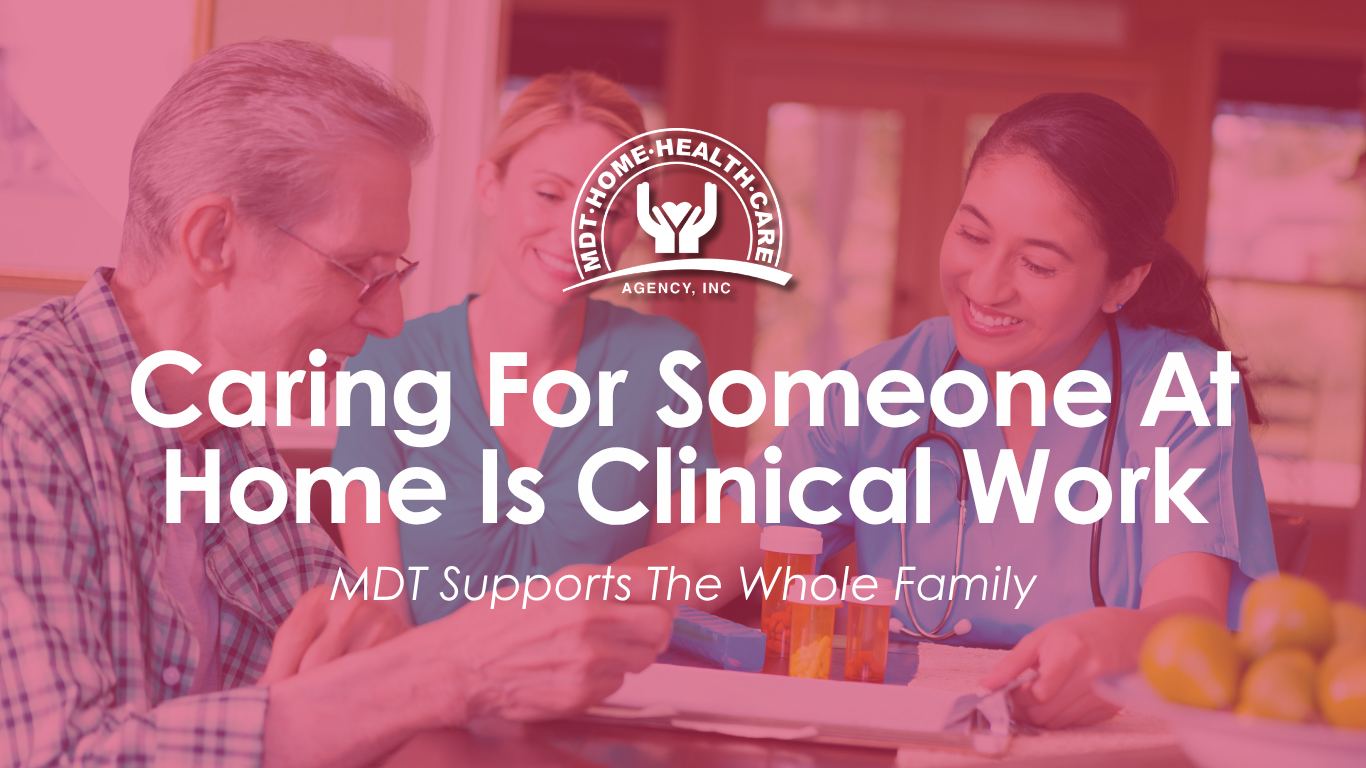
Family caregiver support home health — nurse training caregiver at home


When a patient returns home from the hospital, family caregiver support home health services often make the difference between a safe recovery and a preventable readmission. Family members suddenly manage medications, wound care, and transfers they were never trained to handle.

Medication management. Wound care instructions. Safe patient transfers. Monitoring for warning signs that something has changed.

These responsibilities often require real clinical guidance. Family members taking them on are usually doing their best, often under significant emotional and physical strain, without anyone having sat down to teach them how.

“Caring for someone at home is clinical work, whether or not anyone has named it that way.”

What Family Caregivers Are Often Asked to Do

It’s worth naming, plainly, what a family caregiver’s role often includes after a loved one comes home.

Medication administration. Caregivers often follow a schedule that changed significantly during a hospital stay, sometimes involving multiple medications with different timing and storage requirements.

Wound care. Caregivers change dressings and monitor for signs of infection, often following instructions a nurse gave quickly and verbally in a hospital room.

Safe patient transfers. Caregivers help a loved one move from bed to chair, chair to standing, or in and out of a vehicle — often without training in body mechanics that protects both the patient and the caregiver.

Symptom monitoring. Caregivers must know which changes in condition to expect, which ones raise concern, and when to call the physician or go to the emergency room.

Emotional and physical labor. All of the above, on top of the ordinary demands of life, frequently without a break.

Why Family Caregiver Support Home Health Matters Clinically

It’s tempting to frame caregiver support as a “nice to have” — a softer, secondary concern next to the patient’s clinical needs. In practice, the two connect directly: a caregiver who doesn’t understand how to administer medication correctly, recognize early signs of wound infection, or know when a symptom warrants a call to the physician directly affects the patient’s clinical outcomes.

That is exactly why family caregiver support home health services exist at MDT: to close the gap between a patient’s clinical needs and a family’s readiness to meet them. Effective home health care supports not just the patient, but the family caregiver who carries the work of care between clinical visits.

What Family Caregiver Support Home Health Includes During a Skilled Nursing Visit

When a patient is referred to MDT, support for caregivers may include

→  Caregiver education on safe patient transfer, medication administration, wound care techniques, and symptom monitoring

→  Clear instruction on warning signs to watch for, and how to reach MDT’s 24-hour on-call clinical team

→  Ongoing communication with the caregiver throughout the episode of care, as part of the care team

→  Coordination with the ordering physician when caregiver-reported observations are clinically relevant

Recognizing When a Caregiver Needs More Support

Families don’t always recognize when they’ve taken on more than they can manage safely, often because no one has told them what “equipped” should look like. Signs that a caregiver may benefit from additional clinical education and support include:

·  Uncertainty about how or when to administer medications correctly

·  Difficulty performing wound care as instructed, or uncertainty about what a healing wound should look like

·  Physical strain or fear of injury when helping with transfers or mobility

·  Not knowing which symptoms warrant a call to the doctor versus a trip to the emergency room

·  Visible exhaustion, stress, or a sense of being overwhelmed by the responsibility

None of these signal failure. Instead, they signal that the caregiver needs the kind of structured, clinical instruction a skilled nursing visit provides.

Who Benefits From a Home Health Referral That Includes Caregiver Support

A home health referral that includes meaningful caregiver support may be appropriate when:

→  A family caregiver is managing care responsibilities they have not been clinically trained for and requires skilled nursing instruction

→  The patient is returning home after hospitalization to a primary caregiver who needs guidance on post-discharge care tasks and warning signs

→  The caregiver’s capacity to safely support the patient’s care at home may benefit from skilled nursing assessment and ongoing education

For patients in Miami-Dade and Monroe County, Medicare-covered home health requires a physician’s order and confirmation that the patient meets homebound status under current Medicare guidelines. Learn more about our home health services or visit our referral page for specific eligibility questions.

How MDT Delivers Family Caregiver Support Home Health Services

At MDT Home Health Care, caregiver education is not a brief mention at the end of a visit. Our skilled nursing and therapy team builds it into how they work with every family.

How MDT Supports Caregivers

Hands-on instruction

Nurses show caregivers — not just tell them — how to safely perform the tasks specific to their loved one’s condition and plan of care.

Direct access to clinical support

Our 24-hour on-call team means a caregiver is never facing a question alone at 2 a.m.

Ongoing communication

We check in with caregivers throughout the episode of care, because confidence and competence build over multiple encounters.

Physician coordination

When a caregiver raises a clinically relevant concern, we make sure it reaches the ordering physician.

MDT Home Health Care serves patients and their families across Miami-Dade and Monroe County, Florida. We are Medicare-certified and Joint Commission accredited, with 24-hour on-call clinical support.

For Families Currently Managing Care at Home

If you are caring for a loved one and feel uncertain about any part of their care — medications, wound care, transfers, or simply knowing what’s normal — that uncertainty is a reasonable response to being asked to do clinical work without clinical training. Skilled home health support exists, in part, to close exactly that gap. See our guide to discharge planning and home health coordination for more on preparing for the transition home.

Family caregiver support home health, every day.

Caring for someone at home is clinical work. Family caregivers deserve the same clarity, instruction, and support that any member of a care team would expect — because, functionally, that’s exactly what they are.

At MDT Home Health Care, that is what we are here for: supporting the whole family, not just the patient.

Contact MDT to Refer a Patient →

MDT Home Health Care  ·  Medicare Certified  ·  Joint Commission Accredited  ·  24-Hour On-Call  ·  Miami-Dade & Monroe County, Florida
Fall Risk After Discharge Miami | MDT


Fall Prevention · Discharge Planning · Miami-Dade & Monroe County

Most families brace for the hospital. Fewer expect that the days right after coming home can be just as risky — especially when it comes to falling.

MDT Home Health Care  ·  Miami-Dade & Monroe County  ·  June 2026


Miami home health after discharge — MDT Home Health Care Miami-Dade


Most families brace for the hospital stay itself. Fewer expect that fall risk after discharge can be just as serious — particularly in the days right after coming home.

Fall risk doesn’t end when a patient leaves the hospital. In many cases, it starts there. Deconditioning during the hospital stay, medication changes, new or unfamiliar assistive devices, and a home environment that hasn’t been assessed for a patient’s changed functional status can combine in ways that families don’t fully anticipate — until something happens.

“The body that comes home from the hospital is not the same body that went in. Strength, balance, and confidence all change — and most homes haven’t caught up yet.”

Why fall risk increases after a hospital stay

A hospital stay changes the body, even when the original reason for admission has resolved. Several factors commonly contribute to increased fall risk in the post-discharge period.

Deconditioning. Days of bed rest or limited mobility during hospitalization can weaken muscles and affect balance — often more than patients or families realize until the patient is back on their feet at home.

Medication changes. New prescriptions, adjusted dosages, or discontinued medications can affect balance, alertness, and blood pressure stability. Some combinations increase dizziness or drowsiness in ways that weren’t present before admission.

New or unfamiliar assistive devices. A walker, cane, or other mobility aid introduced during hospitalization is often unfamiliar. Patients and caregivers may not yet know how to use it safely in their own home.

An unassessed home environment. The home a patient is returning to was not necessarily evaluated for their current, post-hospitalization functional status. Stairs, rugs, poor lighting, or a bathroom that was manageable before may now present a real fall hazard.

What a home mobility and safety assessment includes

When a patient is referred to home health following discharge, skilled nursing and — when ordered by the physician — therapy services can directly address this fall risk picture. A home mobility and safety assessment, conducted during the initial skilled nursing visit, typically looks at the following.

What the assessment covers

→  Functional mobility in the actual home environment — not a hospital hallway, but the patient’s own stairs, hallways, bathroom, and bedroom

→  Assistive device use — whether the patient is using their walker or cane correctly, and whether it’s appropriately fitted

→  Medication review for balance-related risk, noting agents that may warrant physician attention

→  Caregiver readiness to safely assist with transfers, ambulation, and recognizing early warning signs

How physical and occupational therapy support safe recovery

When ordered by the physician, physical and occupational therapy play a specific role in post-discharge fall prevention.

Physical therapy focuses on rebuilding strength, balance, and safe ambulation — addressing the deconditioning that often follows a hospital stay and helping patients regain the functional mobility they had before admission.

Occupational therapy addresses how a patient performs daily activities safely within their own home — transfers in and out of bed, bathing, dressing, and the home modifications or adaptive techniques that may reduce fall risk during those activities.

Both disciplines work in coordination with skilled nursing and communicate relevant clinical observations back to the ordering physician throughout the episode of care.

Who is appropriate for a fall-risk-focused home health referral?

A home health referral focused on post-discharge fall risk may be appropriate when a patient:

·  Returns home with new or changed mobility limitations following hospitalization, surgery, or extended bed rest

·  Requires physical or occupational therapy to safely navigate their home environment or regain functional mobility

·  Has a changed medication regimen and whose physician has identified a need for skilled nursing monitoring

·  Lives with a caregiver who requires clinical education on safe mobility assistance and fall risk management

·  Faces a home environment not yet assessed for their changed functional status

For patients in Miami-Dade and Monroe County, Medicare-covered home health requires a physician’s order and confirmation that the patient meets homebound status under current Medicare guidelines. Learn more about our full range of home health services, or visit our referral page for specific eligibility questions.

What post-discharge fall prevention looks like at MDT

At MDT Home Health Care, we support the post-discharge transition with skilled nursing and — when ordered by the physician — therapy services that address this specific clinical picture.

MDT Fall Prevention Process

Home mobility & safety assessment

During the initial skilled nursing visit, focused on the patient’s post-hospitalization functional status in their actual home environment.

Therapy coordination

With physical and occupational therapy, when ordered by the physician, to address safe ambulation, assistive device use, and functional mobility at home.

Medication review

As part of the skilled nursing assessment, noting any agents that may warrant physician attention related to balance, alertness, or blood pressure stability.

Caregiver education

On safe patient transfer, ambulation assistance, and early warning signs of declining stability.

Physician communication

Relevant clinical observations are communicated to the ordering physician throughout the episode of care.

MDT Home Health Care serves patients across Miami-Dade and Monroe County, Florida. We are Medicare-certified and Joint Commission accredited, with 24-hour on-call clinical support.

A note for families

If your loved one has recently come home from the hospital and you’ve noticed they seem less steady on their feet, more hesitant on stairs, or unsure how to use a new walker or cane — that is worth taking seriously, not dismissing as a temporary adjustment. These are often the early, addressable signs of post-discharge fall risk, and skilled home health support exists specifically to address them before a fall happens. For more on preparing for the transition home, see our guide to discharge planning and home health coordination.

Fall risk after a hospital stay is common — and often addressable.

It’s most predictable, and most preventable, in the first weeks at home — when deconditioning, medication changes, and an unfamiliar environment intersect.

At MDT Home Health Care, that is what our skilled nursing and therapy team is here to provide.

Contact MDT to Refer a Patient →

MDT Home Health Care  ·  Medicare Certified  ·  Joint Commission Accredited  ·  24-Hour On-Call  ·  Miami-Dade & Monroe County, Florida